Guides / Opinion
Native Mobile Apps Are Slowly Killing Your Community
Published 27 Aug 2026 · 7 min read
Key Takeaways
- Only one person per household actually uses the community app, usually the bill-payer. Everyone else never installs it, or loses it at the next phone change.
- That is normal for mobile apps: the average app loses 77% of its daily users within 3 days of install, and 90% within 30 days (Quettra data from 125 million devices, via Andrew Chen).
- No vendor in this niche can afford real multi-platform mobile engineering. Read the one-star reviews on any community app's store listing: login loops, OTPs that never arrive, and months of silence from the developer.
- The app gives the committee a second job: post in the app, then post in the WhatsApp group anyway, then still chase fees one by one.
- The slow killer: unread notices make security and maintenance work invisible. Invisible work erodes the will to pay, and collection rates decline house by house.
- The fix is web-first: one always-current version, no install wall, delivered through WhatsApp, which 90.7% of Malaysian internet users already use monthly.
One user per household
Ask any committee member how many residents actually use their community app. Not how many downloaded it during the launch campaign, but how many opened it this month. The honest answer follows a pattern we have seen across taman after taman: one person per household. Usually the one who pays the maintenance fee, and only in the week it is due.
That is not a community app. That is a payment portal with extra steps. And the gap between what the committee bought and what the residents got is not an adoption problem you can fix with another round of flyers at the guardhouse. It is built into the delivery mechanism itself.
The friction ledger
Every native app charges an admission fee before it does anything useful, and residents pay it in effort:
- Install. Find the app, download 80MB, create an account, verify a phone number, allow notifications. Every step loses people. The uncle who "will do it later" never does.
- Phone changes. Someone upgrades their phone every two to three years. The app does not come along automatically in any useful state: reinstall, re-login, OTP to a number they may have changed. If anything fails, they are locked out, and it is nobody's job to let them back in.
- Storage pressure. When a phone runs out of space, the app nobody opens is the first thing deleted. It does not get reinstalled.
- App fatigue. Your residents already juggle banking apps, TnG, work apps, school apps. A community app used twice a month sits at the bottom of the pile, when it is remembered at all.
None of this happens with malice. Each individual friction is small. But they compound quietly, resident by resident, month by month, until the app that launched with 300 downloads has 40 actives. The committee is the last to find out, because the vendor's dashboard counts installs, not attention.
Why the vendors cannot fix it
Here is the uncomfortable economics of the niche. Building a genuinely good native app means supporting at least two platforms (Android and iOS), dozens of OS versions, and thousands of device models, indefinitely. Global companies spend teams of engineers on this. Community management vendors in Malaysia are small companies selling to volunteer committees at neighbourhood prices. Nobody in this market has the revenue to do real multi-platform engineering. So they build an app that is good enough on the phones the developers tested, ship it, and pray.
You do not have to take our word for it. Open the Play Store or App Store listing of any community app sold in Malaysia. Look at the rating. Read the one-star reviews: login loops, OTPs that never arrive, screens that stopped working after an update. Then check the dates on the developer replies, if there are any at all. Reviews describing residents locked out of their own community sit unanswered for months.
And when it breaks, who does the resident complain to? Not the vendor; residents have no relationship with the vendor. They complain to your committee. Which brings us to the part nobody puts in the sales deck.
The app that gave the committee a second job
Committees buy these apps to stop chasing people. Payment reminders, announcements, AGM notices: send once through the app, done. That is the pitch.
The reality: the notification goes out to the minority who still have the app installed, with notifications still enabled, on a phone where it still works. Everyone else hears nothing. So the committee does what it has always done. It forwards the announcement to the WhatsApp group, and chases fees one by one through private messages anyway.
Now count the workflow. Before the app: post in WhatsApp. After the app: post in the app, then post in WhatsApp, then chase individually, then field complaints from residents who cannot log in to see the notice they never wanted to check an app for. The software did not replace a task. It added one. For a volunteer committee, that is not a product. It is a part-time job with a subscription fee attached.
Unread notices are invisible benefits, and invisible benefits stop getting paid for
This is the part that actually kills communities, and it moves slower than any of the above.
Security fees pay for invisible work. The patrol at 3am that nothing happened during. The CCTV that quietly records. The barrier arm that gets serviced before it fails. The drain cleared before monsoon season. When the work is done well, a resident sees nothing: no break-ins, no floods, no incidents. The only way invisible work becomes visible is communication: patrol reports, incident summaries, maintenance updates, accounts.
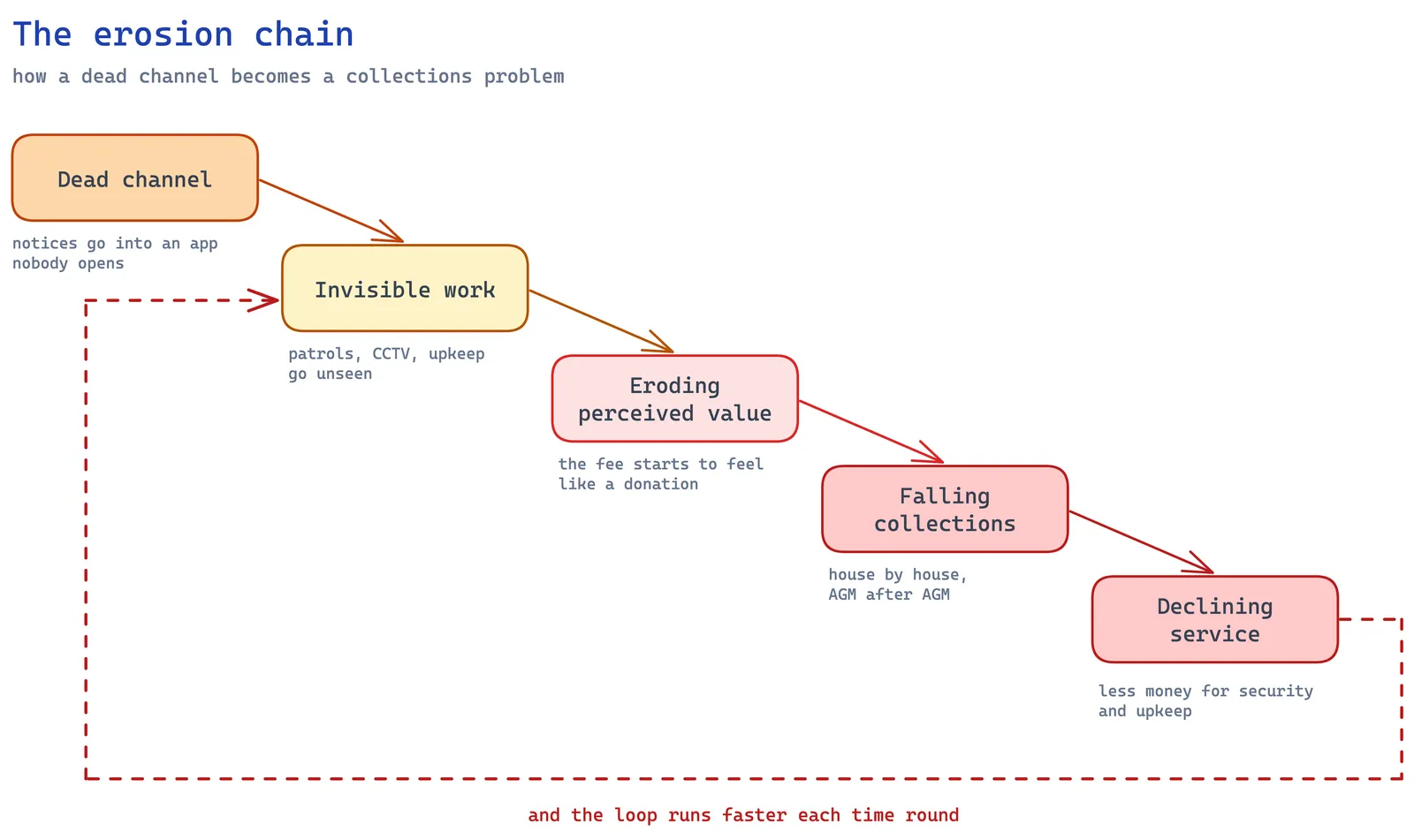
If those updates go into an app nobody opens, then as far as the paying resident is concerned, the work does not exist. And people do not keep paying for things that, from where they sit, do not exist. The fee starts to feel like a donation. Then it feels optional. Then the neighbour who stopped paying faces no visible consequence, and the resident who kept paying starts to wonder why. Collection rates do not collapse overnight. They erode, house by house, in exactly the way committees describe at every AGM: "last year we collected from 80% of houses, this year 65%."
The chain is short and brutal. A dead channel makes the work invisible. Invisible work erodes perceived value. Eroding value drags down collections, which means less money for actual security and maintenance, which means genuinely declining service, which erodes value faster. The app did not just fail to help. Its silence actively fed the decline.
The web-first alternative
This is why we built Teras without a native resident app, and it is a deliberate bet, not a missing feature.
A web platform means there is exactly one version of the software, and it is always the latest one. Nothing to install, nothing to update, nothing that breaks when a phone changes hands. A link opens for every resident instantly: the grandmother on an old Android and the surgeon on this year's iPhone get the same working screen.
Delivery goes where your residents already read: WhatsApp. Fee reminders, receipts, visitor invitations, announcements, all into the channel every resident checks daily, not a channel the committee must beg them to adopt. When the RA drops a link in the group, it opens. There is no install wall between your announcement and the person it is for. And when something does go wrong, support happens in the same place, in a WhatsApp conversation with people who answer, not a review into the void.
Every ringgit that would have gone into maintaining two mobile codebases goes into making one web platform robust instead. That is not thrift; in a market this size, it is the only honest engineering posture.
Where native apps genuinely make sense
To be fair to the other side: native apps earn their cost when the job needs deep hardware access, such as offline-first field tools, specialised camera pipelines, or background hardware integration. If your requirement truly lives there, a native app is the right call and you should demand a vendor with the engineering payroll to sustain one.
But opening an announcement, paying a fee, and pre-registering a visitor are not that. They are links. They have worked in a browser for twenty years.
The question to ask your vendor
If your community runs a native app today, do a five-minute audit before renewal: ask the vendor for monthly active users, not downloads, as a percentage of households. Ask when the app store's negative reviews were last answered. Ask your own committee how many channels they actually post every announcement to.
If the answers are what we think they are, the app is not building your community. It is quietly draining the one asset a residents association runs on: the residents' belief that paying attention, and paying fees, is worth it.
See how Teras works, or start with our comparison of community management software in Malaysia, where we also make this argument with the bias fully visible.
Run your community with Teras
Visitor passes over WhatsApp, guard tools on any phone, and fee collection residents actually pay — everything a well-run community needs from day one.